

Legal AI Advantage Starts With Trusted Knowledge
Inside Legal Platforms, by Bart Bogaerts
At Lexpo, Bart Bogaerts started with a question that feels increasingly urgent for law firms: in a world where every firm uses the same AI tools, what creates real competitive advantage? It is a question worth asking now. The legal market is testing Copilot, Harvey, and Legora. Every month brings another model, another promise, and another internal discussion about where legal AI is heading.
Yet the more these tools become available to everyone, the harder it becomes to claim them as a real differentiator. AI can help firms work faster. It can support drafting and summarizing content, and it can make searching feel more natural. That is valuable progress, but it also raises the floor for everyone. When every firm has access to similar AI capabilities, the advantage needs to be found elsewhere
The Real Value Sits
Underneath the Tools
Most AI conversations still focus on the visible layer.
• Which tool should we buy?
• Which model is best?
• Which vendor moves fastest?
Those questions matter, but they do not explain where long-term advantage will come from. The real difference lies in the layer underneath the tools: the quality of the firm’s data and the structure around its knowledge.
AI depends on the material it can work with. Old drafts, incomplete matters, and messy document collections all affect the quality of the answer. If the system cannot distinguish the right starting point from eight similar versions, lawyers will struggle to trust the output. That is why legal AI becomes less about the tool and more about the foundation.
A firm’s own work product is unique. Its precedents, matter history, and internal know-how cannot simply be bought by another firm. The way a firm structures and governs that material and turns it into reusable knowledge will shape the value it gets from AI.

Firm-Owned Knowledge
Becomes Strategic
For years, knowledge management was sometimes seen as a back-office discipline. Useful, but rarely urgent. AI changes that, as firm-owned knowledge becomes one of the most valuable assets a law firm has. It shows how the firm solves legal problems and captures what worked before. But also, it reflects client preferences and the firm’s way of thinking. External AI tools can support the work, but they do not automatically understand that internal knowledge. They need a trusted layer to work from. That layer needs curated content and clear governance. Next to that, it also requires lifecycle control, so lawyers know whether knowledge is current, approved, and safe to reuse.
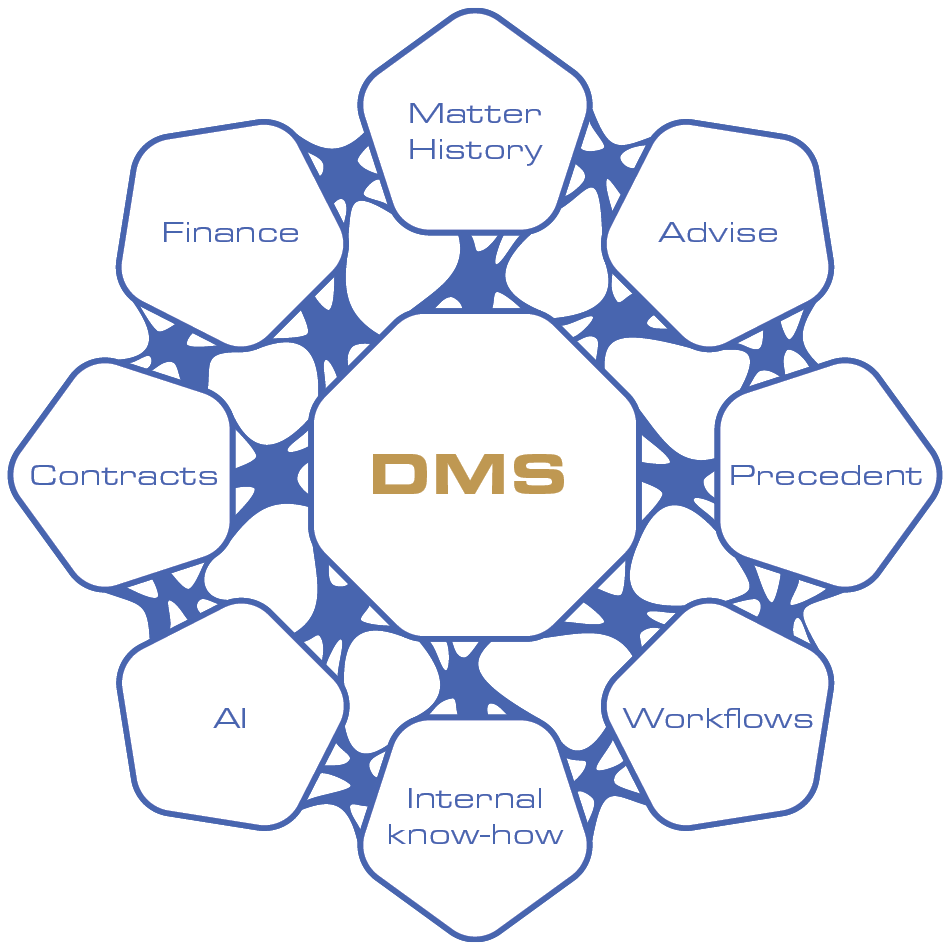
This is where DMS and KMS come together. The DMS connects documents and emails to matters. It adds structure to the legal file. The KMS selects the knowledge worth reusing and makes it easier to trust. Together, they give AI a stronger foundation.

Why the DMS Is Back on the Table
The DMS was once viewed mainly as a place for document storage. That view is too narrow now.
In an AI-driven legal environment, the DMS becomes part of the data foundation. It gives legal content context. It helps AI understand which matter a document belongs to, which version matters, and which permissions apply.
As Bart states it: “Without that structure, AI must work much harder. Lawyers get more noise and search becomes broader, but not necessarily better.” Summaries may look convincing while missing the legal context that makes the answer useful. A modern DMS should make legal work easier for lawyers and more reliable for AI. That is a different role from the traditional repository story.
The Firms With the Best Data
Will Move Faster
The next phase of legal AI will be shaped by firms that know how to organize their own knowledge.
That requires clean matter structures and reliable permissions. It also requires a clear view of which content deserves to become firm knowledge. Epona’s vision fits this perfectly. Epona365 helps firms structure legal work inside Microsoft 365. And our Epona KMS adds the next layer by turning selected know-how into governed, reusable knowledge. AI raises the floor, and trusted knowledge creates the advantage.
