

You already own the foundation to build your legal and AI tools
By Marcel Lang, Epona Co-Founder
"Why does your most important material live where it lives?"
The answer I keep getting
I ask firms a simple question. Why does your most important material live where it lives?
The answers are honest and they are rarely strategic. My predecessor set it up that way. It is what firms like ours use. Our IT supplier recommended it years ago. Nobody chose wrongly. Most of them did not choose at all, because the decision was made once, long ago, by somebody who is no longer there.
That was fine while the decision only affected where files were stored. It affects a good deal more now.
What you already have
Here is the part that gets overlooked. Your firm has already made a major platform decision, and made it well.
Most firms already run Microsoft 365. That means you have a tenant of your own, with your firm’s name on it. You have an identity system that knows who works for you, who left last month and which group each person belongs to. You have classification and retention rules, and a way of applying them. Your people already work in Outlook, Word and Teams all day without thinking about it.
Whatever AI capability Microsoft adds, it arrives pointed at that environment, with those permissions already applied.
That is a foundation. It is paid for, it is maintained by somebody other than you, and your firm has already accepted it.

A foundation is not the whole building
I want to be careful here, because the next sentence gets misread.
A general platform does not know what a matter is. It has no view on how your firm identifies and references its matters, which teams need to be kept apart, or how long a dispute file should be kept compared to a contract. That is not a shortcoming. Microsoft builds something that has to work for a hospital and a law firm at the same time, so it arrives deliberately general.
So a firm needs a legal layer on top. Matter structure, the right metadata, the separation between teams that certain work demands, a way of filing email that a busy person will actually use at six in the evening. I have spent most of my career building exactly that, so I am not about to argue it is unnecessary.
The real question is where that layer sits. On top of the foundation you already own, or beside it with a foundation of its own.

Why it matters more than it used to
It did not always matter this much. For a long time the question was close to a technical preference, and the answer rarely affected anyone outside the IT department.
What changed is that your documents stopped being storage and started being source material. The moment you want useful answers out of your own work, the rules travelling with that work start to matter. Who may see this. What is confidential. What is current and what is superseded. Whether the material can be reached at all by the tools your firm is adopting.
When everything sits inside the environment your firm controls, those rules are already written and already apply. When it sits somewhere else, each of them becomes a separate arrangement with a separate owner.
Neither option is unworkable. One of them simply has fewer moving parts, and fewer places where the answer to “who decided this” is “a supplier”.

The question I would ask
If your firm is making this decision in the next year or two, the comparison worth doing is not a feature list. Most leading software solutions have comparable features.
I would ask three things instead.
In ten years, whose rules govern this material? If the honest answer involves a third party’s policies, you have outsourced something more than storage.
If we wanted to move, what would that actually take? Not whether you plan to. Whether you could.
And when a new capability appears in the platform our people already use, do we get it, or do we wait for somebody to rebuild it for us? This is where the ground you build on shows itself most clearly. Legal software built on Microsoft 365 inherits what Microsoft adds, as it arrives. Legal software built beside it has to have each of those capabilities recreated by its supplier first, if the supplier decides it is worth doing at all.
Those three questions tell you more about the next decade than any demonstration will.

The point
The foundation under your firm is already there. It was chosen, paid for and approved years ago, and most firms treat it as plumbing rather than as the strategic asset it has become.
The decision in front of you is not really which system to buy. It is whether your legal work sits on the ground you already own, or on ground somebody else maintains for you.
Both can be made to work. Only one of them leaves the deciding to you.
Curious what a legal layer on top of Microsoft 365 looks like in practice? Read more on our legal software page.

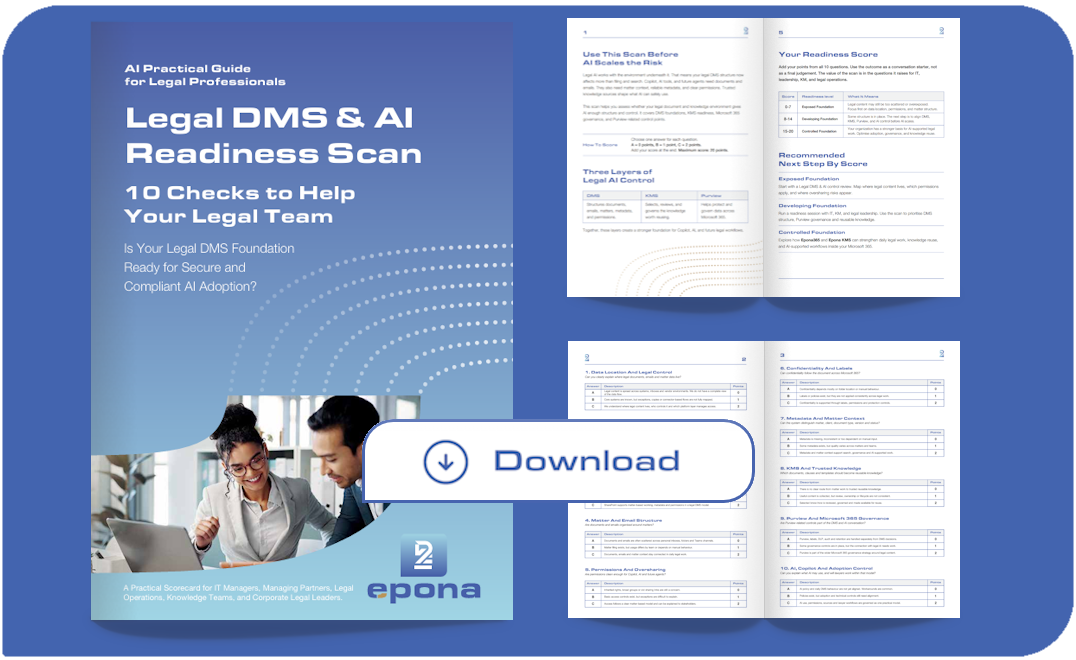
Legal DMS & AI Readiness Scan
Discover 10 practical checks to evaluate whether your legal document environment provides the structure, permissions, metadata, and governance needed to support AI securely and at scale.
This guide also includes a practical Legal DMS & AI Readiness Scorecard that can be used to identify gaps, support internal discussions, and prioritise next steps across DMS, KMS, Purview, and Microsoft 365 governance.
Ready for your next step?
Our team can advise you on how to strengthen your legal team with powerful, AI-driven software solutions for case, document, and knowledge management.
Let’s work together, get in touch with us!