2026 Is the Year Legal Platforms Grow Up
by Marcel Lang
The legal market has spent the last two years examining what AI can do. In 2026, the conversation shifts to what AI can do. That may sound like a subtle difference, but it makes all the difference. Most firms and legal departments have now tested a chatbot, tried a few prompts, or generated a summary. Some of that was useful and some of it was little more than polished autocomplete. In nearly every case, though, AI remained a layer on top of existing work. Helpful on the side, but not part of the core process. That is the phase we are moving beyond.
“We are not building a disconnected AI sidecar.”
Part of a Workspace
In 2026 the legal platform becomes more intelligent, more active, and far more context aware. Documents are classified automatically, and clauses, entities, obligations, dates, and risks are identified. Timelines can be assembled without hours of manual reconstruction. Incoming emails and files do not just land somewhere in the matter. They become part of a workspace that can explain the current state of the work.
That changes the process itself. The old model was simple: users do the work and the system stores the output. The new model is much more dynamic. Information appears, the platform interprets it, places it in context, identifies gaps, surfaces relevant relationships, and helps the professional move forward.
Sharepoint Is Beyond
Content Storage
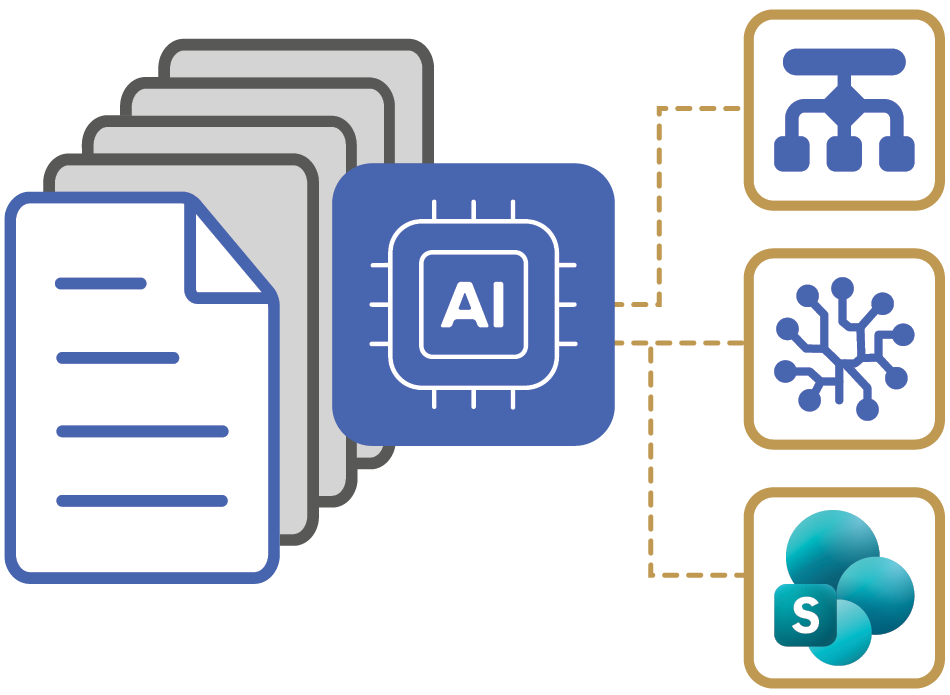
That is why SharePoint has become so strategic as Microsoft is clearly positioning SharePoint as the knowledge layer behind Copilot and agents. That moves SharePoint beyond content storage. It becomes the foundation on which intelligent work is built. For legal teams, that matters because AI only becomes valuable when it is connected to real matters, permissions, workflows and real governance. So, we are not building a disconnected AI sidecar, but we are building a legal platform on top of the Microsoft stack, where document management, knowledge management, governance, and AI reinforce each other. That distinction becomes more important every quarter. The market is moving from reactive to proactive and from search to understanding. But also, from workflow diagrams to agentic processes and from documents as files to documents as knowledge and action.
This also changes the central question. It is no longer “How should users organize documents?” The better question is “How should agents support legal professionals and automate the boring but critical parts of legal work?”

Filing Agents
That starts in very practical places.
- A filing agent that places emails and documents in the right matter automatically.
- A risk agent that flags missing information and legal exposure.
- A case agent that builds chronology from correspondence and documents.
- A lifecycle agent that tracks deadlines and obligations
- A client agent that prepares reporting packages and status updates.
These agents are logical components of a much stronger legal operating model. None of this means legal professionals become less important. That argument was always too simplistic. The real change is in how time gets spent. Less time goes to gathering, sorting, reconstructing, and checking. More time goes to judging, advising, and deciding. The lawyer moves from manual operator to supervisory professional, while the platform absorbs more of the repetitive operational weight.

The Important Role of KMS
This is also why knowledge management is being redefined. For years, KM was something firms believed in but struggled to operationalize. Too much manual work, not enough adoption, not enough time. AI changes that, not by making knowledge magically clean, but by making completed matters, documents, and emails far more useful as sources of precedent, know-how, and reusable insight. Knowledge can increasingly be extracted from the work itself, refined, and reused.
That is what legal platforms are about in 2026: a working environment for knowledge and action with less friction and AI embedded directly into the flow of legal work. The firms and legal departments that lead this shift will not necessarily be the ones running the loudest pilots or buying the most AI products. They will be the ones with the strongest foundation: clean enough structure, real context, proper governance, and a platform designed to support actual work instead of sitting next to it.
So, the future is a legal platform that understands, acts, and supports. By 2026, modesty on that point starts to look less like caution and more like delay.