

SharePoint: the knowledge backbone behind legal AI
Inside Legal Platforms, by Bart Bogaerts
Technology does not often get a second life. Most platforms peak, plateau and gradually fade into the background. SharePoint followed a different path. Quietly, almost unnoticed, it evolved from a collaboration tool into something far more fundamental. Today, it sits at the center of how Microsoft approaches AI. That shift is important, especially for legal organizations, where the value of information has always depended on context, structure and control.
Much of the conversation around AI still focuses on models. But within Microsoft 365, the real differentiator sits elsewhere. AI does not operate in isolation. It depends on a layer that determines what it can see, what it understands and what it is allowed to use. That layer is Microsoft Graph, and beneath that sits the content and knowledge foundation: SharePoint. AI without that layer reads text, but AI with that layer understands context.
More than storage:
where data becomes meaning
It is tempting to think of SharePoint as file storage, but in practice, it behaves very differently. It does not simply hold documents. It:
- structures documents;
- defines relationships;
- controls access;
- tracks versions and applies lifecycle rules;
- connects content to people, to teams and to the work they are doing.
All those elements are essential for AI to function in a meaningful way. Metadata tells the system what something is, permissions determine what is allowed, versioning defines what is current, and structure connects information across matters, teams and processes. With it, AI operates on knowledge.
This becomes even more relevant in legal work, where context is everything. A document only has value when it is understood in relation to the matter it belongs to, the client it serves and the decisions that came before it. The difference between a draft and a final version, between internal reasoning and external advice, is not a detail but a fundamental distinction. Many AI approaches flatten that context. They extract text, index it, and return answers that are often technically correct but difficult to trust. Legal work requires more than retrieval. It requires understanding, and that starts with the structure underneath.

SharePoint powers the
Microsoft AI layer
Within Microsoft 365, SharePoint is not just a data source to AI, but part of the foundation. When Copilot retrieves information, it does not simply look for keywords. It evaluates relevance in context, considering who the user is, what they are working on and what they are allowed to access. It understands which version is leading and how information relates to other documents and activities.
This is possible because SharePoint provides governed content, fine-grained permissions, structured metadata and real-time context through Microsoft Graph. In practice, this means AI is not guessing. This approach differs significantly from many standalone AI solutions, where documents are uploaded, converted into embeddings and stored in a separate index. While useful for experimentation, this often leads to a loss of context. Security needs to be replicated, lifecycle is disconnected from the source, and the relationships between documents are no longer clear. The result is familiar: high recall, but answers that feel incomplete or difficult to verify. SharePoint avoids that problem by remaining the source of truth. AI works on live, governed data instead of a simplified copy of it.
For legal teams, that foundation alone is not enough. Legal work requires an additional layer that reflects how lawyers operate. Professionals do not think in terms of sites or folders, but in matters, and clients. They need clear separation, structured access and a logical way to organize documents, emails and knowledge within that context. This is where Epona adds value as we build on the SharePoint foundation and shape it into a legal work environment, introducing matter-centric structure, legal document logic and a user experience aligned with daily practice.

From tools to foundations
That combination becomes increasingly important as AI moves from experimentation to real application.
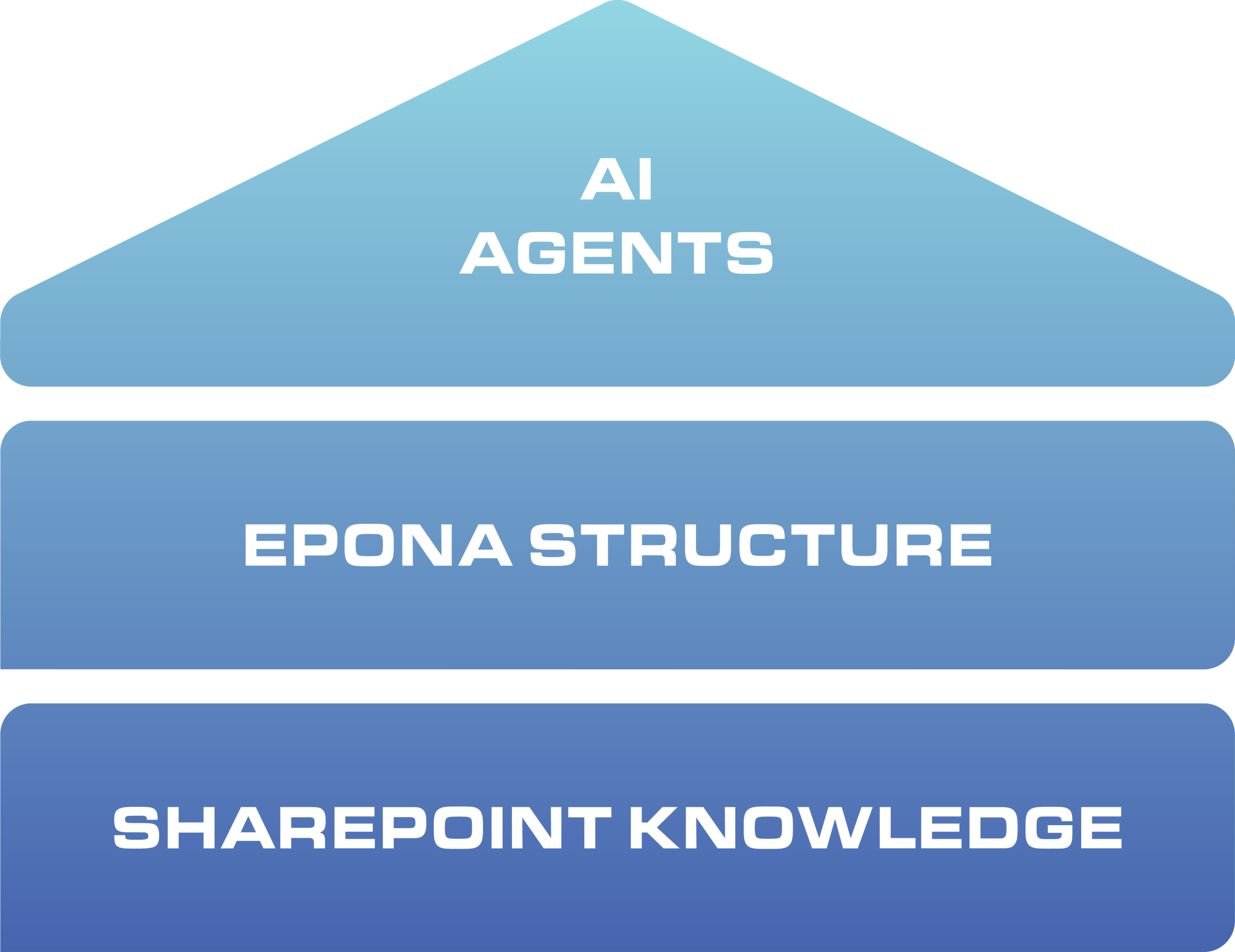
- SharePoint provides the knowledge layer
- Epona structures that knowledge for legal work
- Copilot or other agents can then operate on top of that in a way that is both powerful and trustworthy.
The strength is not in any single component, but in how they reinforce each other.
The legal market is gradually moving beyond the question of which tools to try next. The more relevant questions are becoming structural.
- Where does our knowledge live?
- How is it organized?
- Can we trust the output?
- Does it fit within our governance model?
Those are not feature questions, but architectural ones, and they all point back to the same foundation.
AI will continue to evolve, but capability alone is not what legal organizations need. They need reliability, traceability and control. They need systems that understand context and responsibility. That is why SharePoint matters more than ever: as the layer that turns AI from something that can generate answers into something that can support real legal work.

7 checks before scaling AI across legal work
Discover seven practical checks to assess your AI readiness and gain a clear framework for evaluating whether your document environment is prepared to support AI safely and at scale.
This pages guide also includes a practical DMS, Compliance & AI Checklist that can be used during evaluations, governance workshops and internal readiness reviews.