

Your AI Tool Is Only Meeting Your Legal Data for the First Time
A new AI tool can be implemented in weeks, but the legal information it needs to work with may have accumulated over twenty years. Old matters sit next to new ones, some documents have excellent metadata, while others were filed by someone who left the firm in 2019. Permissions reflect years of projects and team changes. Then AI arrives and is expected to make sense of all of it.
That is a big ask.
AI Inherits the Environment You Already Have
Much of the discussion around legal AI starts with the tool. Copilot, Harvey and Legora are obvious examples, and firms are rightly exploring what each can offer. Once those tools start working with internal legal content, another part of the picture comes into focus. The AI must understand what it is looking at. A final agreement and an early draft can contain very similar language. A clause approved for one jurisdiction may be a poor choice for another. A document can be relevant to a question and still be confidential. That context comes from the environment around the document.
Metadata helps with structure, but clear permissions determine which information a user can access. This is why the legal DMS has become part of the AI conversation.

The DMS Has a Tougher Job Now
A legal DMS still needs to make documents and emails easy to manage. It now also has to provide enough structure for AI-supported legal work. Epona365 builds that legal layer on Microsoft 365 and SharePoint. Documents and emails are connected to matters, while metadata and permissions add the context around them. Our earlier article Your DMS isn’t sexy. Your AI won’t be either looked at exactly this issue: exciting AI capabilities depend heavily on the less glamorous structure underneath them.
Every Document Should Not Carry the Same Weight
The DMS contains the history of legal work, and we all know that that history is valuable, but it is also messy. There may be dozens of versions of a document and several approaches to the same legal question. Some are still relevant, but others belong firmly in the past. A KMS provides a smaller, more deliberate knowledge layer on top of that broader body of work.
Selected precedents can be reviewed, while approved clauses can carry the context lawyers need before reuse. This gives people a trusted collection to work from and gives AI a better-quality source set. We covered that distinction in our article: Your firm already has the knowledge. The problem is knowing what to trust.

Governance Also Lives Outside the DMS: A Look at Purview
Legal information rarely stays inside one application. People work in Outlook and Word, while Teams and SharePoint are part of the same daily Microsoft environment. Microsoft Purview can provide governance across that wider environment. Sensitivity labels and retention controls can travel with information beyond a single matter workspace. For firms already committed to Microsoft 365, this creates a useful combination:
- Epona365 provides the legal document structure
- Epona KMS manages selected knowledge
- Purview supports wider Microsoft 365 governance.
The Legal DMS & AI Readiness Scan uses those same three layers to assess how prepared an organization is for wider AI use.
Look Underneath Before You Add More on Top
There will always be another AI product to evaluate. The more useful exercise is occasionally to look at the environment those products will inherit.
- Can lawyers find the right matter content?
- Are permissions still understandable?
- Is useful know-how being selected and maintained?
Those are ordinary operational questions. They also directly influence how useful AI becomes once it moves into daily legal work. For a broader look at the same issue, Marcel Lang’s Five reasons legal AI needs a stronger foundation goes deeper into the infrastructure behind successful legal AI.

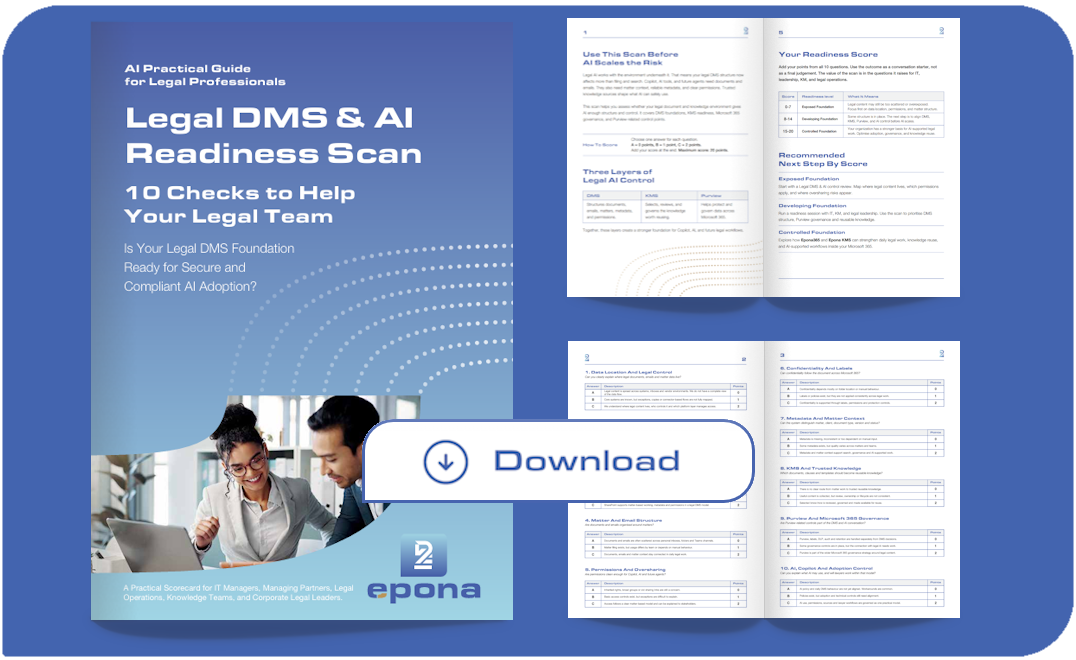
Legal DMS & AI Readiness Scan
Discover 10 practical checks to evaluate whether your legal document environment provides the structure, permissions, metadata, and governance needed to support AI securely and at scale.
This guide also includes a practical Legal DMS & AI Readiness Scorecard that can be used to identify gaps, support internal discussions, and prioritise next steps across DMS, KMS, Purview, and Microsoft 365 governance.